
Contents mold removal in Ocala runs $500–$3,000 depending on volume and material. Leather and textiles take up airborne moisture faster than paint, so a closet shows a humidity problem months before the building does. Many local specialists don't charge for the walkthrough; ask when they call.
Why closets go first, what is realistically recoverable, and how to sort a wardrobe into three honest piles.
Why the closet is the first casualty
Two things happen at once in a closed wardrobe. The materials in it — leather, wool, cotton, paper, cardboard — are hygroscopic, meaning they pull moisture out of the air and hold it. And the air itself barely moves, because a shut door and a closed vent between them remove every source of circulation.
So the closet sits at a higher effective moisture content than the room outside it, on materials that are considerably more edible than latex paint. That is why the first call we get is almost never about a wall. It is about a pair of shoes.
Three piles, sorted honestly
| Pile | What goes in it | Why |
|---|---|---|
| Clean | Hard, smooth, non-porous things; finished leather caught early; most washable textiles | Surface growth, surface treatment, done |
| Treat | Upholstery, structured garments, bags, items with sentimental value | Recoverable with labour, and the labour is the cost |
| Discard | Suede and unfinished leather with established growth, wet cardboard, most affected paper | Cannot be reliably cleaned to a state anybody should certify |
The third column is the one that saves people money. A company that promises to save everything is selling labour that will not deliver, and a company that condemns everything is not looking hard enough.
What a remediator should not do
Fine art, antiques, documents of real value and anything historic belong with a conservator, not a remediation crew. A good specialist will say so, and will not clean something valuable to a standard nobody can guarantee just because the item happened to be in the room.
The closet is telling you about the house
Cleaning the contents and returning them to the same closet buys a few months. The reason the closet was above 60 percent is that the house was, and that is the problem worth solving.
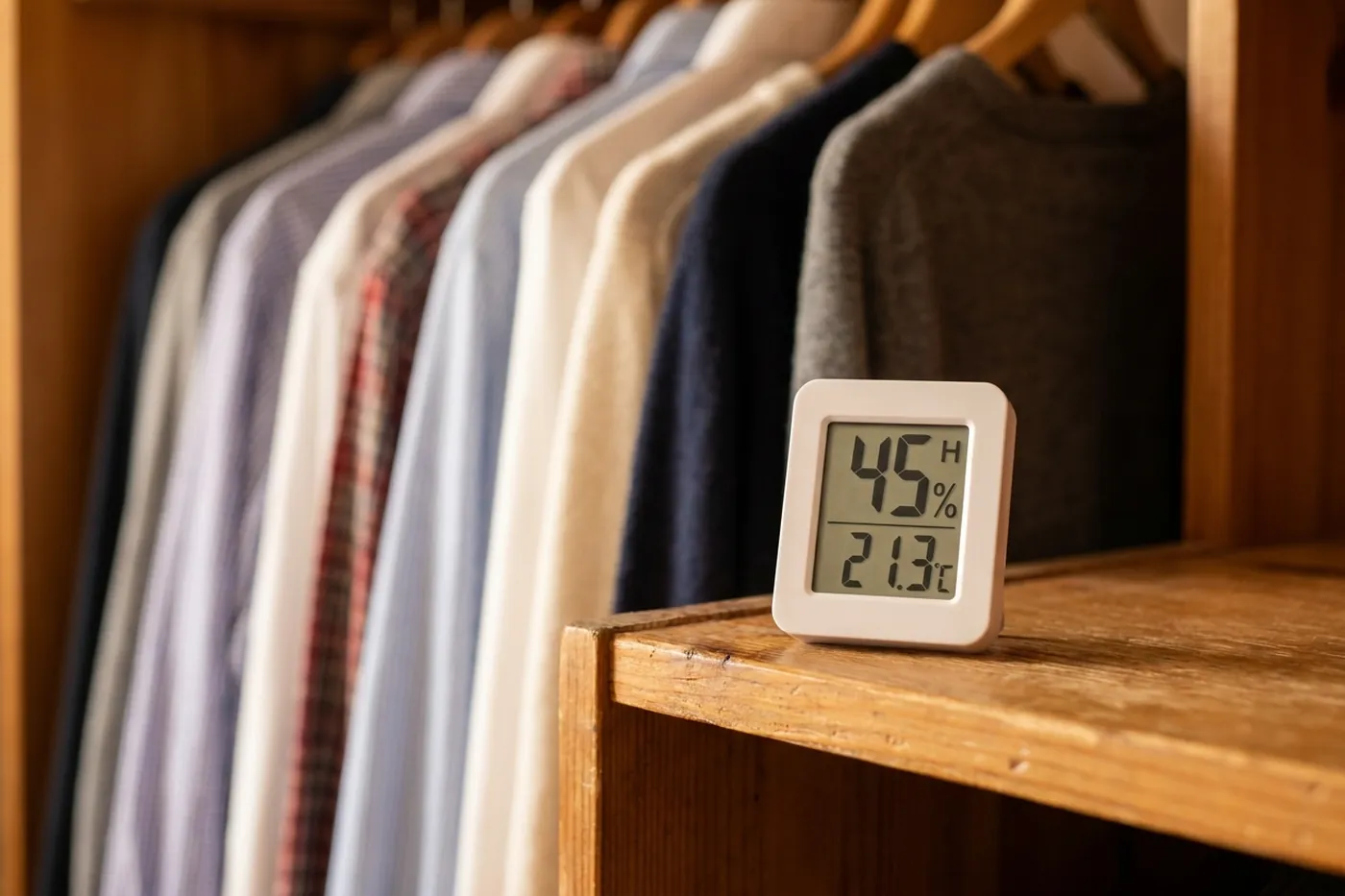
Two things help immediately and cost nothing: leave wardrobe doors ajar so the air in there is the same air as the room, and open the vent in the spare room nobody uses. Then find out what the house is running at — a $12 hygrometer settles in a week what guessing will not settle at all.
Contents, answered plainly
What does contents mold removal cost?
Usually $500-$3,000 depending on volume and on what the items are. Smooth, hard things clean up readily. Leather, suede, upholstered furniture and paper are slower, and some of it is not economic to save whatever anybody promises.
Why do my clothes go mouldy before the walls do?
Because textiles and leather take up moisture from the air far more readily than paint does, and a closed closet has almost no air movement. Your wardrobe is a humidity gauge that reads before the building does.
Can leather be saved?
Frequently, if it is dealt with early. Surface growth on a finished leather shoe or bag often cleans up. Growth that has been feeding on the hide for months, or anything on suede and unfinished leather, is a much poorer prospect and an honest specialist will say so.
What about books and paper?
Paper is difficult. It is porous, it holds moisture, and cleaning is limited to what a surface treatment can reach. Items with real value are worth a conservator rather than a remediation company, and that is where to take them.
Should I just throw everything out?
Not before somebody looks. Plenty of what people write off is recoverable, and plenty of what they try to save is not worth the labour. Sorting it into three piles honestly - clean, treat, discard - is most of the value of the visit.
How do I stop it happening again?
Get the air below 60 percent and get some movement into the closed spaces. Leaving wardrobe doors ajar sounds trivial and genuinely changes conditions in a still corner. The larger fix is whatever is keeping the whole house humid.
Book an Ocala mold walkthrough
If you own a humidity gauge, tell us what it reads and where it sits. If you do not, tell us what the thermostat is set to and whether the house sits empty for part of the year. Those two answers explain more local mold than any description of a stain, and they shape what the specialist brings. A local specialist serving Ocala calls you back.