
Mold removal in Ocala runs $1,500–$6,000 on a typical job, rising to $6,000–$15,000 once the whole house is affected. Local growth is usually airborne moisture, not a leak: above 60% indoor humidity (EPA guidance) ordinary surfaces become habitable. Many local specialists don't charge for the walkthrough; ask when they call.
Why the driest market in the region has a humidity problem, what your air conditioner is and is not doing, and where mold work stops.
Ocala is drier than the coast and damper inside
The rainfall figures are counterintuitive enough to be worth setting out, because they rule out the explanation most people reach for first.
| Market | Annual rainfall | Cooling degree days |
|---|---|---|
| Ocala | 50.80 in | 3,126 |
| Lafayette, LA | 60.50 in | 2,977 |
| Lake Charles, LA | 57.49 in | 2,808 |
| Panama City, FL | 61.08 in | 2,783 |
| Tallahassee, FL | 59.23 in | 2,592 |
Ocala takes nearly ten inches less rain than Tallahassee and works its air conditioning substantially harder. Whatever is feeding local mould, it is not water falling on the roof.
What an air conditioner actually does with moisture
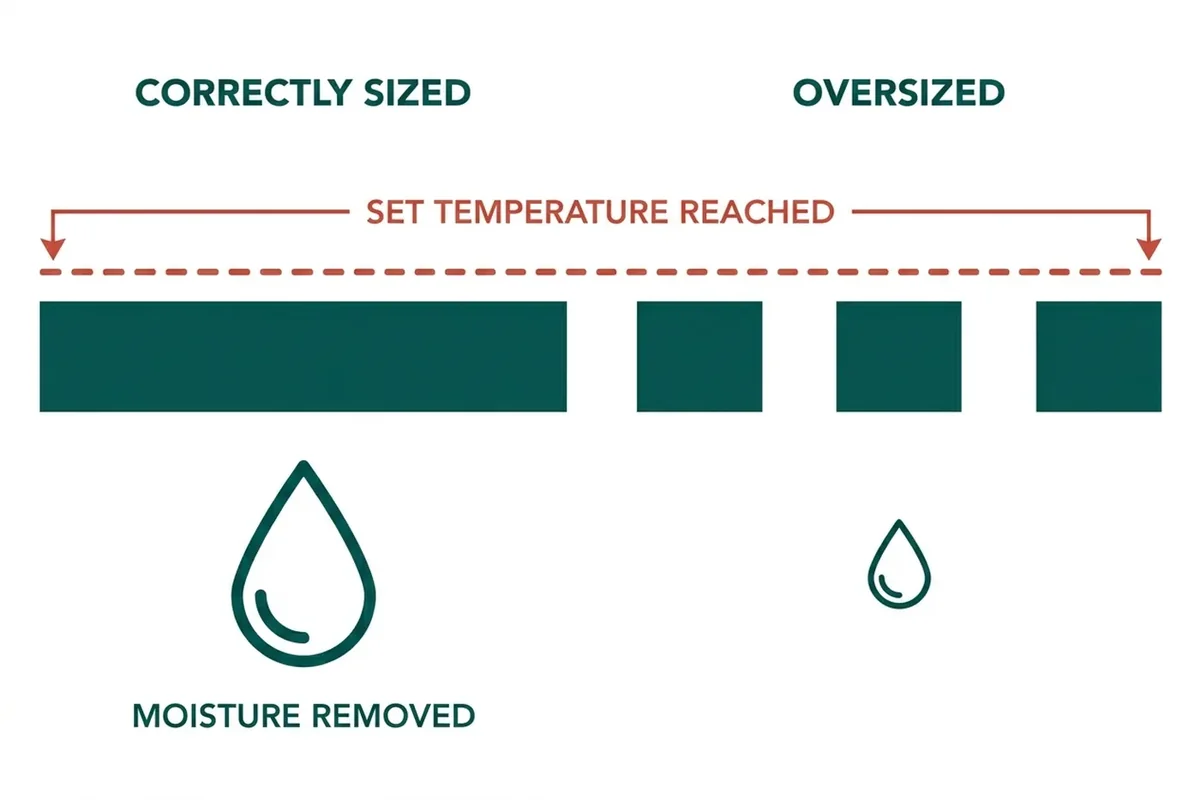
Two jobs, and the thermostat only measures one of them. Cooling drops the air temperature, and that is what makes the system stop. Dehumidifying happens as air passes over a cold coil, water condenses on it and drains away — and that only continues for as long as the system is running.
So run time is the whole story. A unit with more capacity than the house needs hits the set temperature quickly, shuts down, and stops pulling water out well before the house is dry. What you get is exactly what people describe to us on the phone: a house that feels cold and clammy at the same time, often worst in the rooms furthest from the thermostat.
Florida’s energy code takes this seriously enough to legislate against it. Section R403.7 requires equipment sized by ACCA Manual S on Manual J loads and states that the code does not allow designer safety factors or provisions for future expansion. Fitting a bigger unit to be on the safe side is not permitted, because it is not safe.
What humidity-driven growth looks like
- Thin and widespread rather than a defined patch — a haze across a ceiling, a wall behind furniture, the inside face of an exterior wall
- Worst in the still corners: closets, behind headboards, in a spare room with the door shut and the vent closed
- On the soft things first. Leather, fabric and paper take up moisture faster than paint does
- A smell before a stain. Musty air with nothing visible is the standard opening complaint here
- No source you can find, because there is no source in the sense you are looking for
What removal involves, and what it costs
| Situation | The work | Range |
|---|---|---|
| Surface growth over several rooms | Containment, HEPA cleaning, affected porous material out | $1,500–$6,000 |
| Most of the house affected | The same at scale, plus handling contents | $6,000–$15,000 |
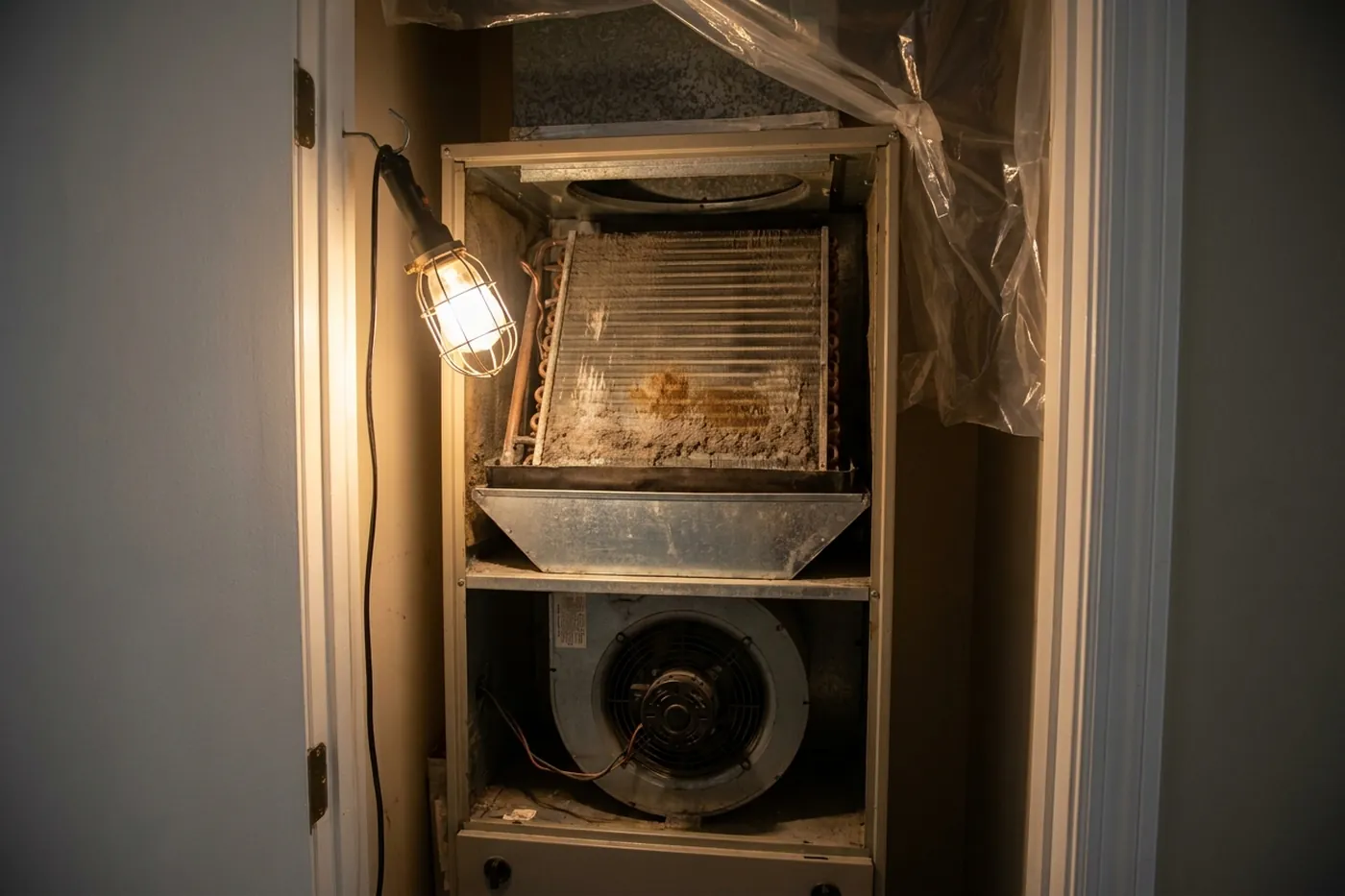
| Growth at vents and the equipment | Coil, pan and cabinet | $1,000–$4,000 |
| Clothes, shoes and stored items | Contents cleaning | $500–$3,000 |
| The walkthrough and written price | Look, read the humidity, quote the removal | Often free |
Where mold work stops, and whose it becomes
A remediator can remove everything that grew and leave the house clean. It cannot make your air conditioner run longer, and that is usually the actual repair. Correcting run time, sealing duct leakage, addressing an oversized system or adding dedicated dehumidification is work for an HVAC contractor, and an honest specialist will tell you that rather than sell you a second remediation next summer.
It costs the remediator the follow-up job and it is the only defensible position. A mould company whose recommendation never involves another trade is describing its invoice rather than your house.
Humidity and mold, answered plainly
How much does mold removal cost in Ocala?
Typical jobs sit in the $1,500 to $6,000 band. Once it has reached the whole house that becomes $6,000 to $15,000, and air handler work is $1,000 to $4,000 on its own. Humidity-driven growth is often spread thin across many surfaces rather than concentrated, which changes the labour more than the materials.
How can I have mold with no leak?
Because mould does not need liquid water, only damp air and something to eat. Above roughly 60 percent indoor relative humidity, ordinary house dust on ordinary surfaces becomes habitable. Nothing has to drip for that to happen.
My house is cool. How can it be damp?
Cooling and drying are two separate jobs an air conditioner does, and only one of them satisfies the thermostat. A system that reaches temperature quickly and shuts off has done the first job and skipped most of the second, which leaves the house cool and wet at once.
What humidity should I be aiming for?
EPA guidance is to keep indoor relative humidity below 60 percent, and ideally between 30 and 50 percent. A $12 hygrometer will tell you where you are, and it is the cheapest useful instrument any homeowner in this county can buy.
Will removing the mold fix it?
It removes what grew. It does not change the conditions that let it grow, so if the air stays above 60 percent the growth returns, usually within a season. That second half of the job is frequently an air conditioning contractor's work rather than mold work.
Does Ocala really get less rain than the coast?
Considerably less. Ocala's annual normal is 50.80 inches against 59.23 at Tallahassee and 61.08 at Panama City, and Ocala carries 3,126 cooling degree days against Tallahassee's 2,592. Drier outside, hotter, and running the air conditioning harder.
Book an Ocala mold walkthrough
If you own a humidity gauge, tell us what it reads and where it sits. If you do not, tell us what the thermostat is set to and whether the house sits empty for part of the year. Those two answers explain more local mold than any description of a stain, and they shape what the specialist brings. A local specialist serving Ocala calls you back.